The CIA Triad: The Architectural Cornerstone of Identity & Access Management
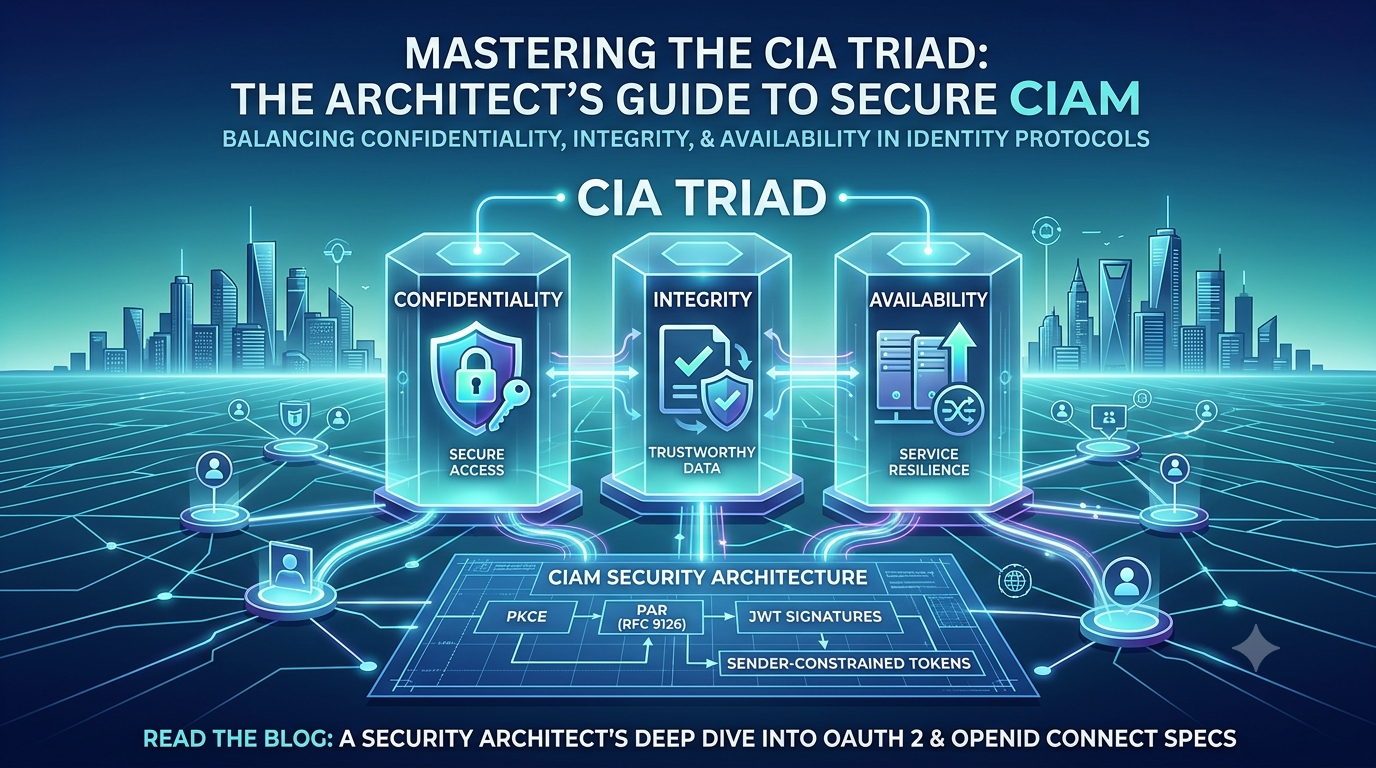
Security architects apply the foundational CIA Triad framework to evaluate risks and build resilient Customer Identity and Access Management systems.
- The Core Properties Breakdown
- Why the Triad is Essential for Security Architects
- CIAM Practical Mapping: OAuth 2.1 & OpenID Connect
- The Extended Model: Adding Accountability & Assurance
- Practical Checklist for Security Reviews
Whether you are evaluating a modern Cloud Native Identity Provider (IdP), designing a Financial-grade API (FAPI 2.0) profile, or threat modeling a custom OAuth 2.1 authorization flow, every security control and design decision you make ultimately traces back to three foundational properties: Confidentiality, Integrity, and Availability—the CIA Triad.
While the CIA Triad is often introduced as a basic concept in security certifications, its true value lies in its power as an architectural evaluation framework. For Customer Identity & Access Management (CIAM) architects, the Triad provides a rigorous lens through which to balance high-security controls against user experience, system resilience, and implementation complexity.
Here is a deep dive into the CIA Triad, how it shapes modern identity architectures, and why every RFC you read is simply an elaboration of these core principles.
The Core Properties Breakdown
At its core, the Triad defines what it means for any digital asset or system to be secure across all three states: at rest, in transit, and in processing.
                   +------------------+
                   |  THE CIA TRIAD   |
                   +--------+---------+
                            |
        +-------------------+-------------------+
        |                   |                   |
        v                   v                   v
+---------------+   +---------------+   +---------------+
| CONFIDENTIALITY|   |   INTEGRITY   |   | AVAILABILITY  |
|  Secrets Stay |   | Tamper-Proof  |   | Systems Ready |
|    Secret     |   |     Data      |   |   & Responsive|
+---------------+   +---------------+   +---------------+
1. Confidentiality: Secrets Stay Secret
Definition: Ensuring that information is accessible only to entities (users, clients, or services) that possess explicit authorization to read it.
- Primary Enforcers: Symmetric and asymmetric encryption, least-privilege access control, strong authentication, data classification, and token binding.
- Core Threats: Eavesdropping/packet sniffing, credential harvesting, excessive scopes/permissions, token theft, and unintentional data exposure via URL parameters or application logs.
2. Integrity: Unauthorized Alteration Prevention
Definition: Guaranteeing that data and systems remain accurate, complete, and unmodified—neither accidentally through transmission errors nor maliciously through tampering. System Integrity extends this to guarantee that a system performs its intended function without unauthorized manipulation.
- Primary Enforcers: Cryptographic hashing, asymmetric digital signatures, strict input validation, code signing, and immutable audit logs.
- Core Threats: Man-in-the-Middle (MitM) parameter manipulation, SQL/Command injection, Authorization Code injection,
alg:noneJWT attacks, and software supply chain corruption.
3. Availability: Systems and Data on Demand
Definition: Ensuring that systems, endpoints, and data assets are responsive and accessible to legitimate users whenever required.
- Primary Enforcers: Redundancy, automated failover, geo-distributed load balancing, rate limiting, distributed denial-of-service (DDoS) mitigation, and key management fallback patterns.
- Core Threats: Distributed Denial of Service (DDoS) on token endpoints, ransomware, single points of failure (SPOFs) in Identity Providers, resource exhaustion, and improper key-rotation strategies.
Why the Triad is Essential for Security Architects
Without the Triad, answering the question “Is this architecture secure?” is impossible because “secure” is too ambiguous. With the Triad, the question decomposes into three measurable design criteria:
- Is the data confidential enough for its classification?
- Is its integrity verifiably protected against tampering?
- Is the service resilient enough to remain available under load or attack?
Key Architectural Utilities:
- Exposing Inherent Tensions: The three properties frequently conflict. Strict confidentiality controls (e.g., mTLS mutual authentication or complex cryptographic operations) can degrade availability or user experience if latency spikes or certificates expire. High availability (e.g., aggressive caching edge-nodes) can expose confidential data if tokens or user claims are stored without proper isolation.
- Requirements Decomposition: Standards like NIST SP 800-63, ISO 27001, PSD2/SCA, GDPR, and FAPI 2.0 are not arbitrary lists of rules—they are concrete frameworks designed to enforce specific properties of the Triad.
- Framing Threat Modeling: The Triad maps directly to frameworks like STRIDE:
- Spoofing & Information Disclosure $\rightarrow$ Confidentiality
- Tampering & Repudiation $\rightarrow$ Integrity
- Denial of Service $\rightarrow$ Availability
CIAM Practical Mapping: OAuth 2.1 & OpenID Connect
In modern Customer IAM and Open Banking environments, security failures rarely stem from ignoring the Triad entirely—they stem from optimizing heavily for one property while unwittingly exposing another.
Below is a practical mapping of how the CIA Triad manifests within a production OAuth 2.1 / OIDC architecture:
| Triad Property | Threat Vector | Modern CIAM Control Stack (RFCs) |
|---|---|---|
| Confidentiality | • Bearer token theft & leakage via browser history |
• Scope inflation
• Authorization Code interception | • DPoP (RFC 9449) & mTLS (RFC 8705) sender-constraining |
• Pushed Authorization Requests (PAR / RFC 9126) to hide parameters from URLs
• Short-lived Access Tokens (RFC 9068) with explicit aud claims | ||
| Integrity | • Auth Code Injection attacks |
• Redirect URI parameter tampering
• Token signature forgery ( alg:none) | • PKCE (RFC 7636) with S256 challenge |
• JWT Secured Authorization Response Mode (JARM) & JAR (RFC 9101)
• Asymmetric token signing using strict typ: at+jwt enforcement | ||
| Availability | • Authorization Server (AS) outages |
• DDoS on /par or /token endpoints
• Cache stampedes during JWKS key rotation | • Active-Active multi-region AS deployments |
• Rate limiting per client ID on PAR/Token endpoints
• Short-TTL local JWKS caching with kid-miss fallback re-fetching logic |
The Extended Model: Adding Accountability & Assurance
While the three-part model remains the foundational baseline, standards like NIST SP 800-27 extend the Triad with two additional properties crucial for enterprise and CIAM environments:
                    +-----------------------+
                    | EXTENDED CIA MODEL    |
                    +-----------+-----------+
                                |
        +-----------------------+-----------------------+
        |                                               |
        v                                               v
+---------------+                               +---------------+
| ACCOUNTABILITY|                               |   ASSURANCE   |
| "Who did it?" |                               | "Is it working?"|
+---------------+                               +---------------+
- Accountability (Non-Repudiation & Traceability): Ensuring that every system action, token issuance, or data access request can be uniquely traced back to the exact actor who performed it.
IAM Implementation: Unique subject identifiers (
sub), client tracking (client_id), single-use token identifiers (jticlaims), and immutable append-only audit logs for all PAR and token exchange operations.- Assurance (Confidence in Controls): The operational proof and continuous evidence that your security controls are configured correctly and functioning as designed.
- IAM Implementation: Automated FAPI 2.0 conformance testing, dynamic OAuth security scans, continuous penetration testing, and real-time posture monitoring.
Practical Checklist for Security Reviews
When reviewing an architecture proposal, RFC draft, or technical integration, evaluate every component against this simple 4-step checklist:
- Explicit Property Evaluation: Never assume protecting one property implicitly protects the others. Evaluate Confidentiality, Integrity, and Availability as distinct requirements.
- Identify the Weakest State: Analyze data at rest, in transit (over the wire), and in processing (in browser memory or gateway caches).
- Validate Incident Containment: During incident response, ensure recovery efforts do not sacrifice one property to restore another (e.g., bringing a service back online to restore Availability before verifying database Integrity after a breach).
- Trace Controls to Goals: Every security control in your architecture must map directly to a property in the Triad. If a control cannot be mapped to protecting Confidentiality, Integrity, or Availability, it is likely redundant overhead.
Key Takeaway for Architects
The power of the CIA Triad lies in its simplicity. Technologies, protocols, and threat vectors continuously evolve, but the core objective of a Security Architect remains static: building resilient systems where secrets stay secret, data remains trustworthy, and services remain reachable when needed.